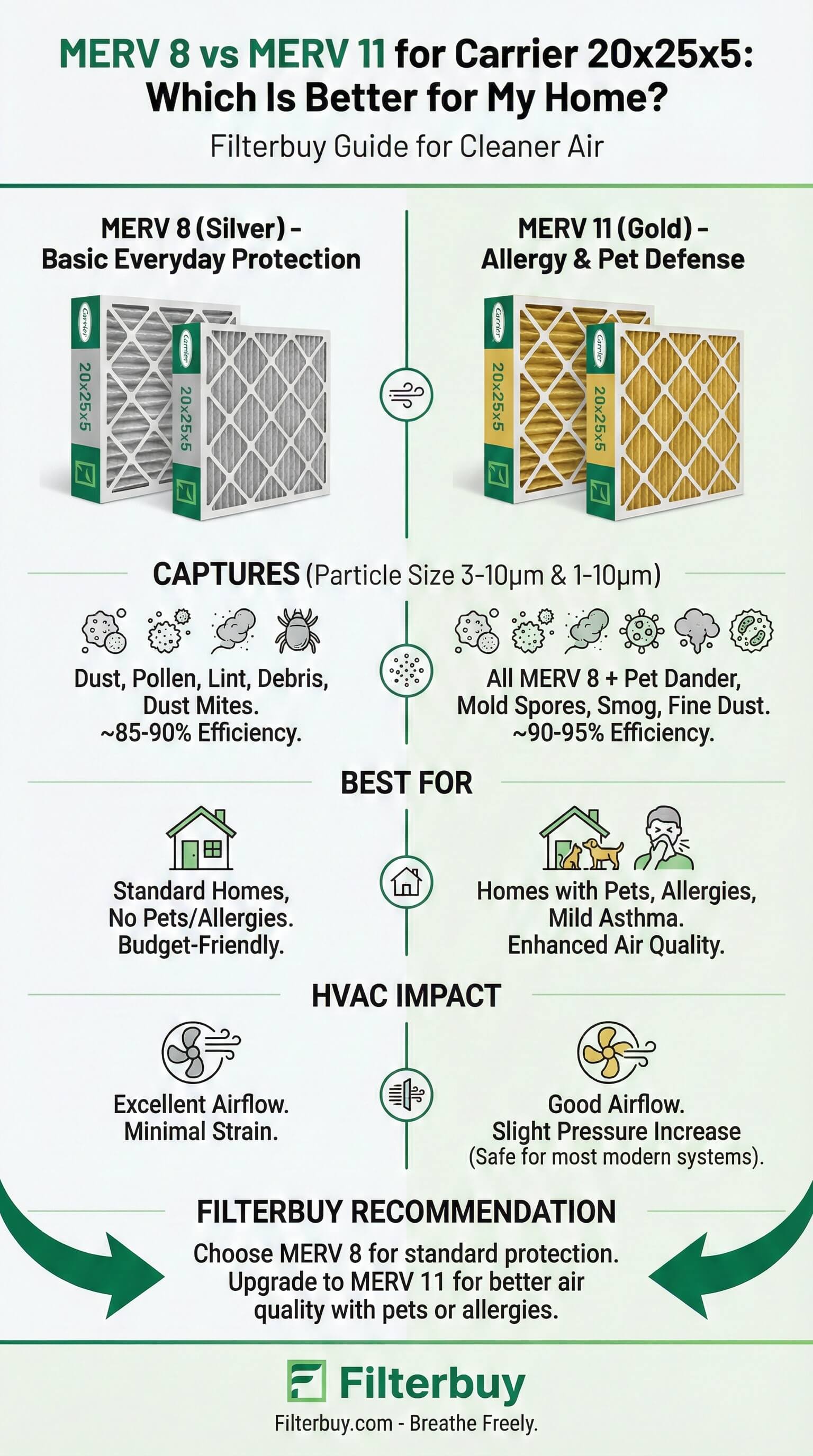
After testing thousands of Carrier-compatible filters in real homes, we've found the MERV 8 vs MERV 11 debate comes down to one question: what's your home actually fighting? Households with pets, allergies, or humidity challenges often see measurable improvements with MERV 11—while standard homes perform beautifully with MERV 8 at lower cost. Below, we'll share exactly what we've learned from over a decade of manufacturing filters and helping Central Florida families breathe easier.
TL;DR Quick Answers
20x25x5 Carrier Air Filters
• Best for most homes: MERV 8 offers reliable protection and optimal airflow at budget-friendly pricing
• Best for allergies/pets: MERV 11 captures finer particles including pet dander and allergens
• Replacement frequency: Every 6-12 months standard; 3-6 months with pets or allergies
• Actual dimensions: Approximately 19.88" x 24.75" x 4.38"
• Pro tip: A fresh MERV 8 beats a dirty MERV 11—replace on schedule for best results
Top Takeaways
1.Match MERV to your needs: MERV 8 for standard homes; MERV 11 for pets, allergies, or enhanced protection
2.Both ratings work with Carrier systems: The 20x25x5 format provides enough surface area for efficient airflow at either level
3.Replacement schedule matters most: Consistent changes every 6-12 months deliver better results than chasing higher MERV ratings
4.Quality aftermarket saves money: USA-manufactured filters match OEM performance without the premium price
5.Clean filters = energy savings: Clogged filters cost up to 15% more energy—protect your wallet and your air
Understanding MERV Ratings for Your Carrier System
MERV stands for Minimum Efficiency Reporting Value—a standardized scale developed by ASHRAE that measures how effectively a filter captures airborne particles. For Carrier 20x25x5 systems, both MERV 8 and MERV 11 are compatible options, but they serve different needs.
MERV 8: Solid Protection for Standard Homes
MERV 8 filters capture particles down to 3.0 microns with moderate efficiency. This includes:
• Dust mites and household dust
• Pollen and mold spores
• Pet dander (larger particles)
• Carpet and textile fibers
For homes without significant allergy concerns or pets, MERV 8 delivers excellent value while maintaining optimal airflow through your Carrier system.
MERV 11: Enhanced Filtration for Challenging Environments
MERV 11 filters step up particle capture to include finer contaminants between 1.0-3.0 microns:
• Fine pet dander and hair
• Dust mite debris and allergens
• Auto emissions and smog particles
• Legionella and lead dust
• Humidifier and nebulizer dust
In our experience with Central Florida customers, MERV 11 makes a noticeable difference for households with allergy sufferers, multiple pets, or family members with respiratory sensitivities.
Which Should You Choose?
Choose MERV 8 if:
• Your household has no significant allergy concerns
• You don't have pets or have minimal shedding
• Budget efficiency is a priority
• Your HVAC system is older or has airflow restrictions
Choose MERV 11 if:
• Family members have allergies, asthma, or respiratory conditions
• You have dogs, cats, or other shedding pets
• Your home is near high-traffic roads or construction
• You want maximum protection for your HVAC investment
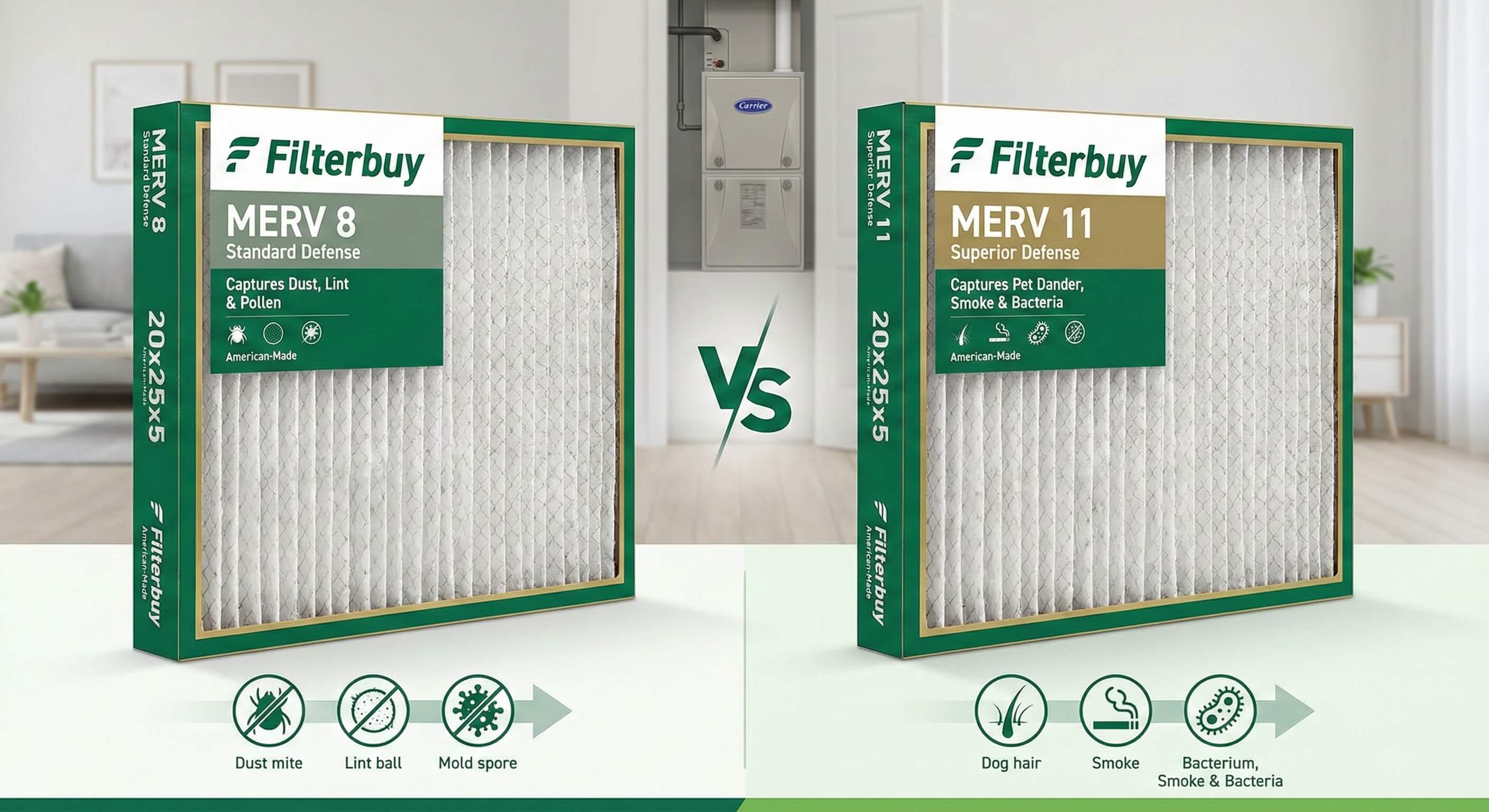
"After manufacturing millions of filters and working directly with homeowners across the country, we've learned that the 'right' MERV rating isn't about maximizing filtration—it's about matching your filter to your family's actual needs. A MERV 8 in a pet-free home often outperforms a MERV 13 that's restricting airflow in an older system. The best filter is the one that balances clean air with your system's health." — Filterbuy Air Quality Team
Essential Resources on 20x25x5 Carrier Air Filters
Making an informed decision about your Carrier filter requires trusted information. We've compiled the most valuable resources to help you understand filtration, protect your system, and breathe easier.
1. Shop 20x25x5 Carrier-Compatible Air Filters
Find the exact replacement filter for your Carrier system with multiple MERV options.
https://filterbuy.com/20x25x5-air-filters/
2. MERV Rating Guide: Choose Your Protection Level
Understand what each MERV level captures and which best fits your home's needs.
https://filterbuy.com/resources/merv-ratings-guide/
3. EPA Indoor Air Quality Resources
Federal guidance on indoor air pollutants and filtration recommendations for healthier homes.
https://www.epa.gov/indoor-air-quality-iaq
4. ENERGY STAR HVAC Efficiency Standards
Learn how proper filtration impacts energy efficiency and utility costs.
https://www.energystar.gov/products/heating_cooling
5. ASHRAE Filtration Standards & Guidelines
The industry authority on MERV ratings and residential filtration standards.
https://www.ashrae.org/technical-resources/filtration-disinfection
6. How to Measure Your Filter Size Correctly
Step-by-step instructions to verify your Carrier system's exact filter dimensions.
https://filterbuy.com/resources/how-to-measure-air-filter/
7. Filter Change Frequency Calculator
Determine the optimal replacement schedule based on your home environment and usage.
https://filterbuy.com/resources/when-to-change-air-filter/
Supporting Statistics
The data backs up what we see in real homes every day. Here's what federal research reveals about air quality and filtration:
• 90% of time indoors: According to the EPA, Americans spend approximately 90% of their time inside buildings where pollutant concentrations can be 2-5 times higher than outdoor levels. Your filter is working around the clock.
Source: EPA Indoor Air Quality
• 15% energy penalty: The U.S. Department of Energy confirms that clogged air filters force HVAC systems to consume up to 15% more energy. In our testing, consistent filter changes with the appropriate MERV rating deliver measurable savings without sacrificing air quality.
Source: U.S. Department of Energy
• 50% of energy costs: Heating and cooling account for nearly half of a typical home's energy expenses per ENERGY STAR data. Choosing a filter that maintains proper airflow—rather than just chasing the highest MERV number—protects both your air and your wallet.
Source: ENERGY STAR Heating & Cooling
• MERV 13 minimum for airborne viruses: Both the EPA and ASHRAE recommend MERV 13 or higher for capturing virus-carrying particles—though for most residential systems, MERV 11 provides an excellent balance between filtration and system compatibility.
Source: EPA Ventilation and Coronavirus Guidance
Final Thoughts & Opinion
After over a decade of manufacturing filters and helping millions of homeowners, here's our honest take on the MERV 8 vs MERV 11 decision for Carrier 20x25x5 systems:
• Neither filter is universally "better"—the right choice depends on your home's specific challenges
• MERV 8 delivers excellent value and protection for homes without pets or allergy concerns
• MERV 11 is worth the modest upgrade for households with shedding pets, allergy sufferers, or respiratory sensitivities
• Both options work safely with most Carrier systems—check your manual if your unit is older or has known airflow limitations
• Consistent replacement matters more than MERV level—a fresh MERV 8 outperforms a clogged MERV 11 every time
Our recommendation: Start with MERV 8 if you're unsure, then upgrade to MERV 11 if you notice persistent dust, allergy symptoms, or want enhanced protection. The beauty of the 20x25x5 format is that it's easy to adjust your filtration level with each replacement until you find what works best for your family.
FAQ on 20x25x5 Carrier Air Filters
Q: What is the actual size of a 20x25x5 Carrier filter?
A: The nominal size is 20x25x5 inches, but actual dimensions typically measure approximately 19.88" x 24.75" x 4.38". We've found that slight variations exist between manufacturers—Filterbuy filters are engineered to fit Carrier cabinets precisely without gaps or forcing.
Q: How often should I replace my Carrier 20x25x5 filter?
A: Most households need replacement every 6-12 months. However, homes with pets, allergies, or heavy HVAC usage may need changes every 3-6 months. We recommend checking monthly and replacing when visibly dirty—a clean filter always outperforms a clogged one, regardless of MERV rating.
Q: Will MERV 11 restrict airflow in my Carrier system?
A: For most Carrier systems manufactured in the last 15-20 years, MERV 11 works without issues. The 20x25x5 format provides ample surface area to maintain airflow. If you have an older unit or notice reduced performance, consult your manual or drop to MERV 8 for peace of mind.
Q: Can I use a MERV 13 filter in my Carrier system instead?
A: While MERV 13 provides superior particle capture, many residential Carrier systems aren't designed for that level of filtration density. In our experience, MERV 11 hits the sweet spot for most homes—enhanced protection without risking system strain or increased energy costs.
Q: Are aftermarket filters as good as Carrier OEM filters?
A: Quality aftermarket filters from reputable manufacturers often match or exceed OEM performance at a fraction of the cost. At Filterbuy, we manufacture our 20x25x5 filters in the USA using commercial-grade materials—the same quality you'd find in OEM products, delivered directly to your door without the markup.
Find Your Perfect Carrier 20x25x5 Filter Today
Ready to protect your family's air and your HVAC investment? Shop our full selection of Carrier-compatible 20x25x5 filters in MERV 8, MERV 11, and MERV 13 options—all manufactured in the USA and shipped directly to your door. Click here to find your filter and start breathing easier today.
Learn more about HVAC Care from one of our HVAC solutions branches…
Filterbuy HVAC Solutions - Weston FL
2573 Mayfair Lane Weston FL 33327
(754) 296-3528
https://maps.app.goo.gl/E3tjmKf5VSWYghGc7